
Direct answer: not yet. Sand.ai launched MAGI-2 on November 24, 2026 as a hosted model, exclusive to Higgsfield, and said open weights will follow. It gave no date, no licence and no hardware target. What is open today is the smaller MAGI-2 Preview from August: code under Apache 2.0, about 307 GB of weights, 10-second clips, and a stated requirement of eight NVIDIA Hopper-class GPUs. Nobody is running either model on a desktop graphics card.
Contents
- What is released and what is promised
- 480B or 400B?
- What it would take to run
- What open weights would change
- Where to use MAGI-2 today
- FAQ
What is released and what is promised
| MAGI-2 Preview | MAGI-2 | |
|---|---|---|
| Announced | August 5, 2026 | November 24, 2026 |
| Total parameters | About 114B | About 480B |
| Active per token | About 6B | About 28B |
| Clip length | 10 s only | Up to 30 s |
| Output | 512×896 preview stage, refined to 1088×1920 | 1080p at 25 fps |
| Sound | Yes, generated with the video | Yes: dialogue, effects, ambience, music |
| References and editing | Not the focus of the release | 20 references, timeline control, video editing |
| Code | Public on GitHub, Apache 2.0 | Not released |
| Weights | Public on Hugging Face, about 307 GB | "Coming soon" |
| Hosted | No official service | Higgsfield (web and API), LibTV in China |
Preview figures are from Sand.ai's GitHub README; MAGI-2 figures are from Sand.ai's launch post.
The exact wording matters. Sand.ai's post says it will follow up soon with open-source releases and a technical report covering the architecture, systems and evaluations. That is a statement of intent. Until a repository and a licence exist, MAGI-2 is a closed, hosted model. Check the licence on the Hugging Face model card before building on the Preview weights too: the README states Apache 2.0 for the code.
Sand.ai has a record here. MAGI-1 was released with weights in 2025, and the Preview shipped with code and weights on the day it was announced.
480B or 400B?
Two numbers are in circulation on launch day:
- 480B total, about 28B active is what Sand.ai's technical post and Higgsfield's product page say about the model you can use now.
- "400B-parameter open weights coming soon" is what Sand.ai's launch announcement on X and Higgsfield's posts say about the future release.
Sand.ai's launch announcement: $0.08 per second on Higgsfield, and 400B-parameter open weights coming soon.
@magiai_hq on X
Neither company has explained the difference. Three readings are possible: the 400B figure is rounded marketing; the open release leaves out a component that the 480B count includes; or the open model is a different, smaller checkpoint. The third would matter most, because the open weights would then not be the model that produced the launch demos.
Until the technical report is out, treat "the open MAGI-2" and "the MAGI-2 on Higgsfield" as possibly two different things.
What it would take to run
Sand.ai has not published requirements for MAGI-2. The Preview gives a baseline, and the arithmetic from there is simple.
What the Preview needs, as stated in its README:
- About 307 GB of weights to download.
- Eight NVIDIA Hopper-generation GPUs (the H100 family).
- The preview and refiner stages do not fit together on one 80 GB card at 1080p.
- Output is fixed at 10 seconds, and the base model is not step-distilled. A distilled version is listed as coming soon.
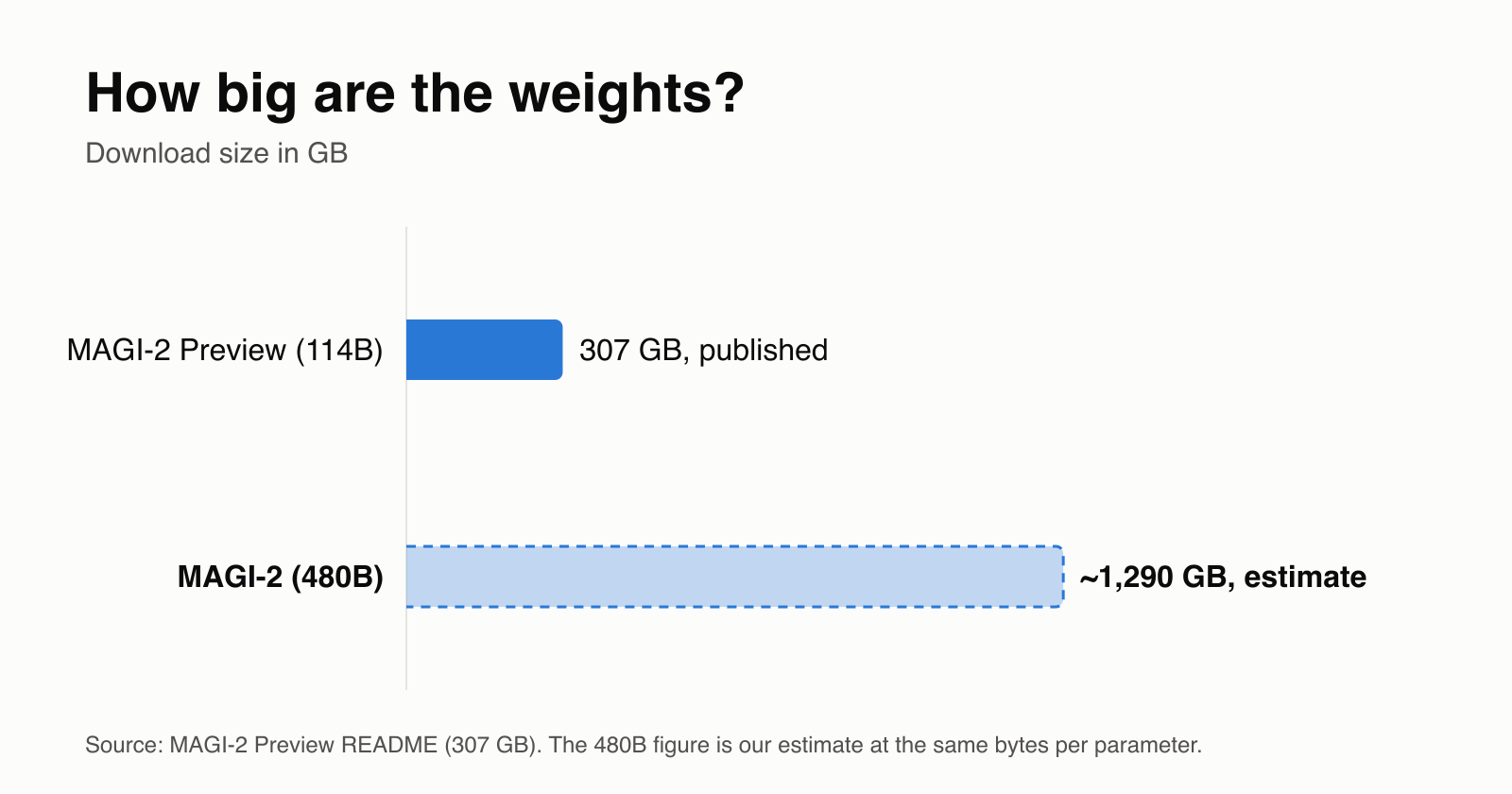
Scaling that to 480B:
| Parameters | Weights on disk | |
|---|---|---|
| MAGI-2 Preview | 114B | 307 GB (published) |
| MAGI-2 at the same bytes per parameter | 480B | about 1,290 GB (our estimate) |
| MAGI-2 at 8 bits per parameter | 480B | about 480 GB (our estimate) |
| MAGI-2 at 4 bits per parameter | 480B | about 240 GB (our estimate) |
The estimates are plain multiplication: 307 GB for 114B parameters is about 2.7 GB per billion, and 480 times that is about 1.3 TB. Sand.ai has not announced quantised versions, and nobody knows yet how much quality a model like this loses at 4 bits.
Why "only 28B active" does not make it small. MAGI-2 is a mixture-of-experts model: each token passes through a small share of the network, which is why it is cheap per second. But different tokens use different experts, so all of the weights have to be loaded and reachable. Compute scales with the 28B; memory scales with the 480B.
What that means for hardware:
- A 24 GB or 32 GB consumer card is out by a factor of roughly ten, even for an aggressive 4-bit version.
- A 30-second clip is three times the Preview's length, with references on top, so activations need more memory too.
- A realistic home for the full weights is a multi-GPU server or a cloud cluster. Open weights here mean "any company can host it", more than "anyone can run it".
If you want something to run locally this year, the piece to watch is the distilled Preview that the README lists as coming soon, and any smaller model Sand.ai releases alongside the full one.
What open weights would change
Even if few people can run them, released weights would change three things for everyone who uses the model through a website:
- More places to use it. Today MAGI-2 runs on one platform outside China. With open weights, any inference provider can host it, and platforms like Yovid can offer it.
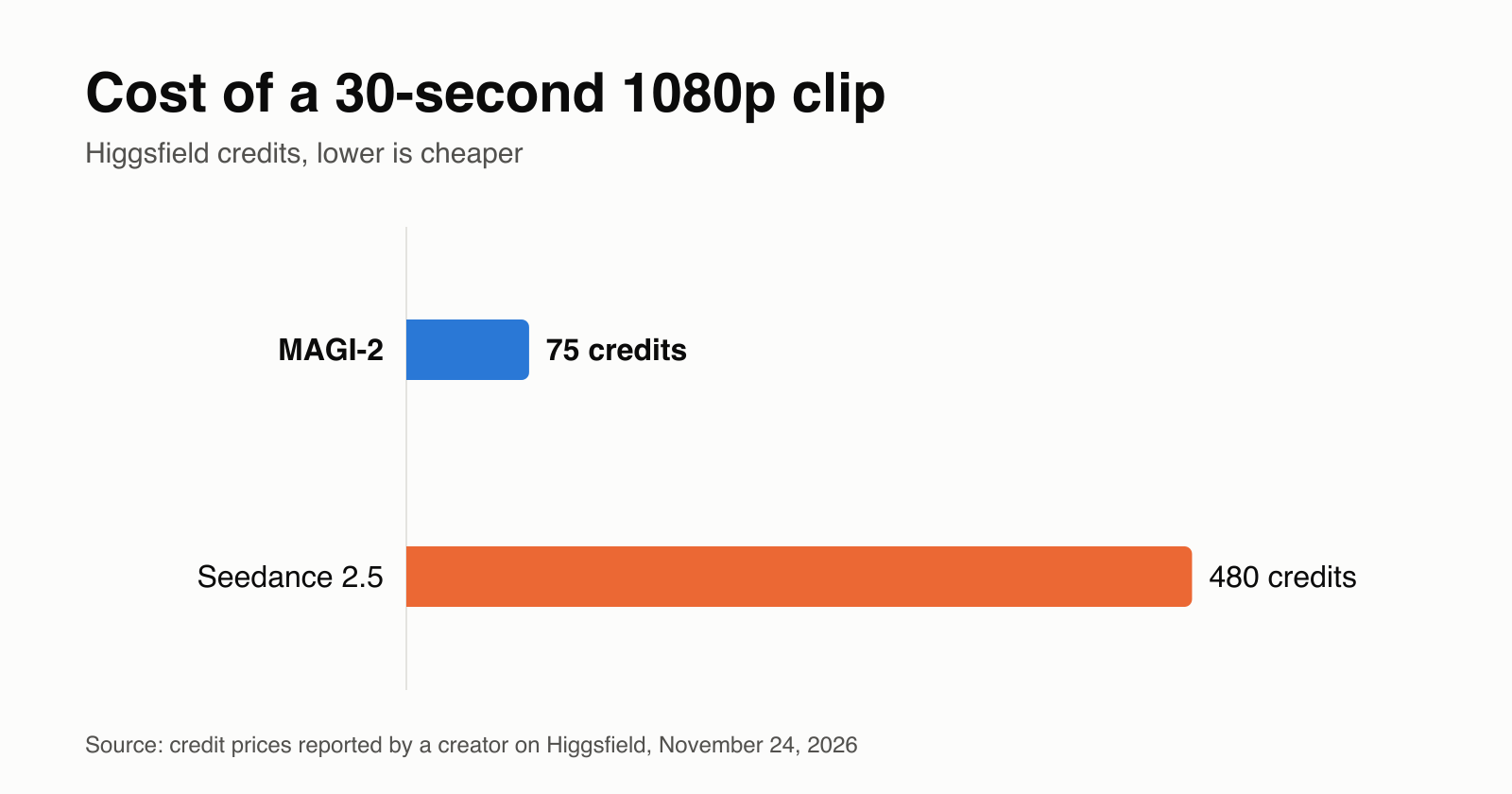
- Price pressure. $0.08 per second is already about 6.4 times below Seedance 2.5 on the same platform. Competing hosts tend to push a price down further, as happened with the Wan models.
- Fine-tuning. Creators are already talking about training LoRAs for their own characters and styles. That depends on the licence and on someone providing the compute, and it is the reason open video models built communities that closed ones did not. Note that this particular post is a paid partnership.
There is also a research reason to want the weights. Sand.ai reports that the 480B model, before final tuning, could solve Sudoku grids on screen and plan its own shots, and that tuning for looks made those abilities hard to trigger. An open release that includes the pre-tuning checkpoint would let others study that. Sand.ai has not said which checkpoint it will release.
The 480B pre-trained checkpoint filling in a 9×9 Sudoku with prompt rewriting off, from Sand.ai's launch post.
Where to use MAGI-2 today
| Web | Higgsfield, exclusive at launch |
| API | Higgsfield API |
| China | LibTV |
| Price | $0.08 per second of generated video; $2.40 for 30 s at 1080p |
| Higgsfield credits | 75 for 30 s at 1080p, as reported by a creator on launch day |
| China price | ¥0.5 per second at 1080p, as reported by Kazik (数字生命卡兹克) |
| Free tier | None announced for MAGI-2 |
| Sand.ai's own site | No MAGI-2 generation announced at launch |
"Exclusive" has no stated end date. Sand.ai calls Higgsfield its launch partner, which suggests other platforms later, and open weights would make that automatic.
Yovid does not run MAGI-2. Our MAGI-2 page tracks its status. If you need a 30-second take with sound today, Seedance 2.5 and Wan 3.0 both do it on Yovid. For how MAGI-2 performs, see the MAGI-2 review, and for the head-to-head, MAGI-2 vs Seedance 2.5.
FAQ
Is MAGI-2 open source?
Not as of November 24, 2026. Sand.ai says it will open-source MAGI-2 and publish a technical report, with no date. The MAGI-2 Preview from August is open: code on GitHub under Apache 2.0 and weights on Hugging Face.
When will MAGI-2 weights be released?
Sand.ai says "soon" and has given no date. Its launch announcement describes the coming release as 400B parameters.
Can I run MAGI-2 on an RTX 4090 or 5090?
No. The smaller Preview already needs eight data-centre GPUs and 307 GB of weights. The full model is about four times larger.
What is the difference between MAGI-2 Preview and MAGI-2?
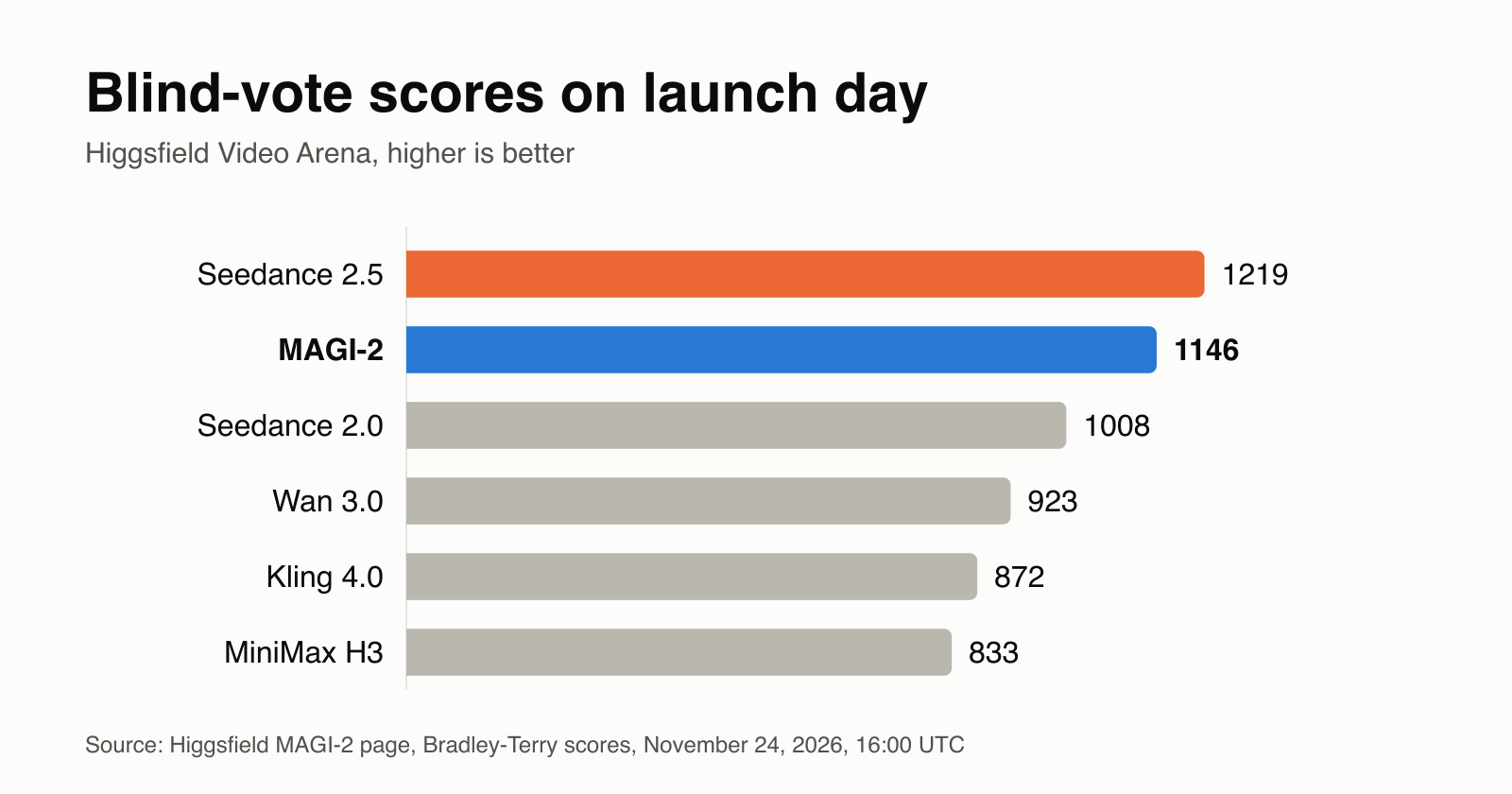
The Preview is a 114B research release limited to 10-second clips. MAGI-2 is the 480B flagship: 30 seconds, 1080p at 25 fps, references, timeline control and editing. On the Artificial Analysis Video Arena, Sand.ai reports 998.5 for the Preview and 1150.3 for MAGI-2.
Is MAGI-2 free?
No free allowance has been announced. It costs $0.08 per second on Higgsfield.
Does MAGI-2 work in ComfyUI?
There is no MAGI-2 release to load. Community support depends on the weights being published, and on hardware that can hold them.
Is MAGI-2 on Yovid?
No. It is exclusive to Higgsfield at launch.
Want a 30-second take with sound while you wait? Open the AI video generator and choose Seedance 2.5.