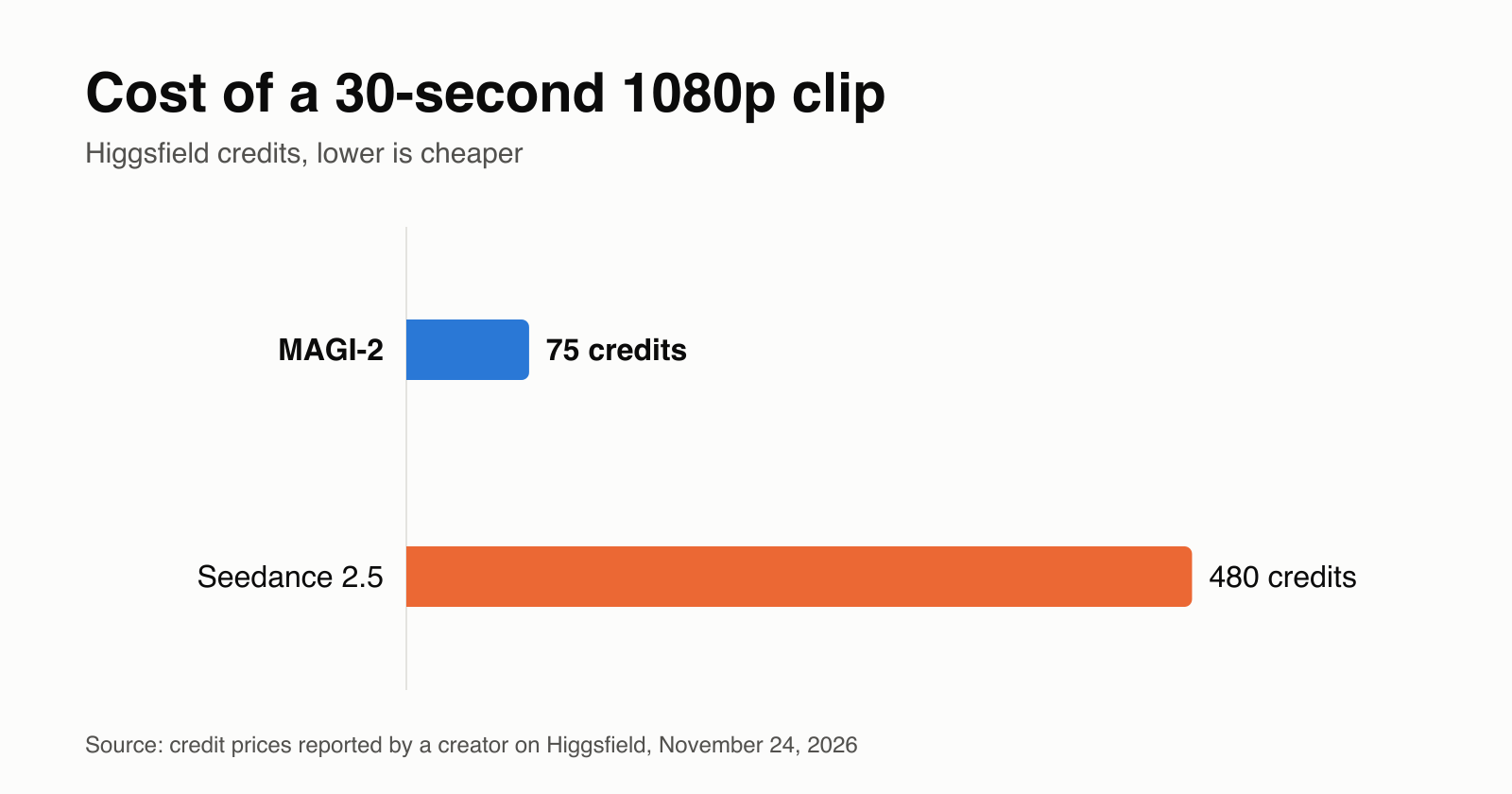

Direct answer: on day one, MAGI-2 looks like the first model that gets close to Seedance 2.5 on long takes while costing a fraction of it: $0.08 per second of 1080p video with sound. Independent testers rate its camera work and prompt-following at or above Seedance 2.5, its physics slightly below, its picture a little harsher, and its voices clearly behind. Yovid does not run MAGI-2, and we did not generate any of the clips here: the videos on this page are Sand.ai's official demos and posts from people who had access.
Contents
- What this review is based on
- MAGI-2 at a glance
- Camera moves: the strongest result
- Physics: three clean scenes, two flaws
- Style: it stays in the style you asked for
- References: 20 files, and they hold
- Editing: change a clip by describing it
- Sound: the weak point
- What Sand.ai says it cannot do yet
- How much of the praise is paid
- Four prompts to run the same tests yourself
- Who should use MAGI-2 now
- FAQ
What this review is based on
Three kinds of source, all from November 24, 2026:
- Sand.ai's own launch post, which gives the model size, the limits and a list of known weaknesses.
- One long independent test, by the Chinese AI video writer Kazik (数字生命卡兹克). He had access before launch and published seven test clips with the full prompts, including a side-by-side against Seedance 2.5.
- Posts on X from people who ran it on Higgsfield, the launch partner. We read the 29 posts with more than 50 likes about ten hours after launch, plus smaller ones that contained an actual comparison.
Where a claim comes from a sponsored post, we say so.
MAGI-2 at a glance
| MAGI-2 | |
|---|---|
| Made by | Sand.ai (Beijing) |
| Launched | November 24, 2026 |
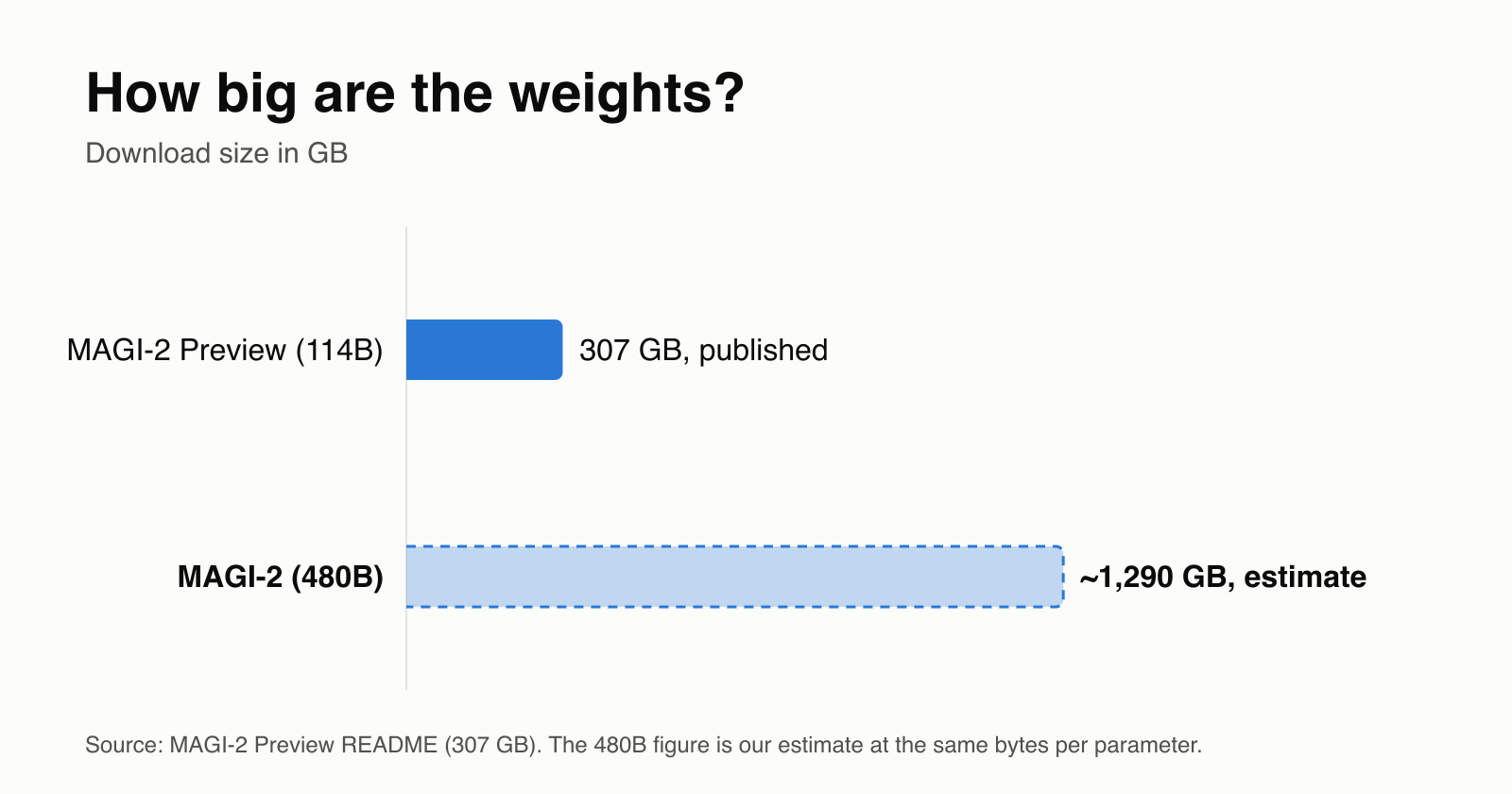
| Size | About 480B parameters in total, about 28B active per token |
| Clip length | Up to 30 seconds |
| Output | 1080p at 25 fps, six aspect ratios |
| Sound | Generated with the picture: dialogue with lip-sync, effects, ambience, music |
| References | Up to 20 per request: 10 images, 5 videos, 5 audio clips |
| Editing | Changes to an existing clip by description; timeline and cut control |
| Where it runs | Higgsfield (web and API) worldwide; LibTV in China |
| Price | $0.08 per second on Higgsfield; ¥0.5 per second on LibTV, as reported by Kazik |
| Open weights | Promised, with no date or licence yet |
Figures are from Sand.ai's launch post, Higgsfield's MAGI-2 page and Kazik's article.
Sand.ai's launch reel, as posted on X:
Sand.ai's launch reel for MAGI-2: 1 minute 47 seconds of official demo footage.
@magiai_hq on X
Camera moves: the strongest result
This is where MAGI-2 surprised the people testing it.
Test 1: a 14-second orbit. Kazik asked for an iPhone-style shot that tracks a model in a long coat from the side, arcs behind her, climbs to a top-down view, drops to a close-up of her face, then pulls back and up to a high view of the city. One take, with the instruction that the background must show real parallax instead of rotating like a flat backdrop. The first generation did all of it, and slowed down at two points in a way that reads as deliberate. He then showed colleagues the same prompt from other models without labels, and they picked MAGI-2.
Test 2: a 30-second paper plane. One continuous take following a paper plane from a school rooftop, down into a corridor, through a classroom, out of a window, along the outside wall, into the ground-floor hall and across a lawn into a girl's hand, with the camera passing under the wing and rolling once on its axis. MAGI-2 held the space together from room to room.
What failed, for every model: the first version of that prompt sent the plane down a stairwell. Neither MAGI-2 nor the other models he tried could draw a stairwell that stayed structurally correct while the camera moved through it. He replaced it with an open window and the take worked. If your shot depends on stairs, expect to redesign it.
On X, a sponsored post made the same point with a rotating city shot that held one look for 15 seconds, and a Japanese creator described the camera movement and colour grading as the standout.
A Japanese creator's first MAGI-2 clip on Higgsfield, with dialogue generated in Japanese.
@AI__TSUBAKI on X
Sand.ai's own camera demo is about cuts instead of one long take: a 30-second prompt with 15 shots and a hard cut every two seconds, played against the timeline it was asked to follow. Sand.ai says that in its timeline benchmark all 16 specified cut points landed on target.
MAGI-2: 15 shots in 30 seconds with a cut every two seconds, from Sand.ai's launch post. The strip underneath is the requested timeline.
Physics: three clean scenes, two flaws
Kazik packed five physics problems into one clip with hard cuts: a boot kicking apart a snow pile, a glass jar of sweets shattering on tiles, a person slipping into a pool, a shaken cola bottle spraying across a floor, and a balloon full of coloured powder bursting. He ran the same prompt on Seedance 2.5 and published both.
| Scene | MAGI-2 | Seedance 2.5 |
|---|---|---|
| Kicked snow | Clean | Clean |
| Jar of sweets shatters | Bounces look right, but in slow motion many sweets break up or smear | Cleaner |
| Fall into the pool | Clean | Clean |
| Cola bottle sprays | Spray is the wrong colour for cola | Small flaw too |
| Powder balloon bursts | Not singled out | Not singled out |
His conclusion: Seedance 2.5 is a little better overall, and MAGI-2 is far closer to it than he expected. Sand.ai's own post agrees on the weak spot: very fast motion can still produce broken trajectories.
Style: it stays in the style you asked for
Two tests, both one take:
- Layered paper-cut animation, 18 seconds: indigo paper waves, a red carp jumping a gold gate and turning into a dragon. The clip stayed paper-cut from start to finish. Kazik's point was that the model did not drift toward glossy 3D, even where it could have made the frame look richer.
- Thick oil paint, 20 seconds: a red-sailed boat in a storm, with spray turning into a gold nebula. Visible knife texture throughout.
Sand.ai's showcase has a harder version of the same idea: one 30-second take that moves through five painting styles, guided by five reference paintings including The Starry Night and Water Lilies.
MAGI-2: one 30-second take through five painting styles, from Sand.ai's launch post. Unmute for the sound.
One caution from Sand.ai itself: in medium and wide shots, 2D animation can look too smooth in small local motion.
References: 20 files, and they hold
MAGI-2 takes up to 10 images, 5 videos and 5 audio clips in one request.
- Kazik rebuilt a viral clip using a reference video taken from X plus character, prop and scene images made with GPT Image. The 27-second result kept the character and props consistent.
- A Turkish creator gave it two characters made in Midjourney and two locations made with GPT Image 2.6 and reported Seedance-level output on the first try. His post is marked as promotion.
- The most useful short note came from a small account that ran the same reference-to-video job on MAGI-2, MiniMax H3 and Seedance 2.5: MiniMax H3 failed, MAGI-2 came close to Seedance 2.5 but a little worse, and its picture was too contrasty.
That last point matches Kazik's verdict that image texture is the one visual area where MAGI-2 sits below Seedance 2.5. Sand.ai explains part of how it keeps identity at 1080p: the upscaler is given the original reference images again, which helps small faces and on-screen text survive a 30-second scene.
Sand.ai's reference demo locks one character, her clothes and three flower settings (an iris hillside, a rose garden and a lily valley) with reference images, then moves between close-ups, low angles and wide shots:
MAGI-2: one character held across three settings with reference images, from Sand.ai's launch post.
A 42-second MAGI-2 clip built from two character images and two location images. The author marks the post as promotion.
@ozansihay on X
Editing: change a clip by describing it
Nobody outside Sand.ai published an editing test on day one, so the only evidence is the official one. Sand.ai took a screen recording of its own MAGI-2 Preview homepage and edited it with text instructions: the cursor turns into an eraser and rubs out the word "Preview", then the planet in the background collapses into a black hole that swallows the page and leaves the new title on black.
MAGI-2: a screen recording edited by text instructions, from Sand.ai's launch post.
It shows the model can change a real recording, text and all, and keep the cursor and layout believable until the effect takes over. It does not show how well it handles a small, precise change to ordinary footage, which is the more common job.
Sound: the weak point
MAGI-2 generates dialogue, effects and music with the picture, and one tester reported native Japanese dialogue working. The quality is where it falls short.
Kazik's test was a science teacher tapping a glass bottle, adding water and tapping again so the pitch drops, with three spoken lines. The staging, the cuts and the timing of the taps were fine. The voice sounded synthetic. He puts MAGI-2's audio at about the level of Seedance 2.0, a full generation behind Seedance 2.5, and says Sand.ai told him it is working on it. Sand.ai's limitation list says the same thing in other words: complex soundscapes need richer layering and more physical realism.
If your video depends on a believable voice, this is the reason to stay on Seedance 2.5 or to replace the voice track afterwards.
What Sand.ai says it cannot do yet
The launch post lists four limits:
- Extreme high-speed motion can produce trajectory or continuity errors.
- Medium- and wide-shot 2D animation can look overly smooth.
- Complex soundscapes lack layering and realism.
- Polishing the model cost it some of what it had learned.
The fourth is the most interesting thing in the post. Before the final tuning, the 480B model showed abilities nobody trained it for: it solved 9×9 Sudoku grids on screen, planned its own shots and cuts from a three-line story outline, and translated dialogue into another language without a language model rewriting the prompt. After tuning on a few thousand hand-picked clips, the picture got better and those behaviours became much harder to trigger. Sand.ai compares this to the "alignment tax" seen in language models.
Two clips from that earlier checkpoint, both generated with prompt rewriting switched off:
The 480B pre-trained checkpoint filling in a 9×9 Sudoku, from Sand.ai's launch post.
The same checkpoint staging a dialogue between Lu Su and Zhuge Liang from three story beats, with no shots or cuts specified. From Sand.ai's launch post; unmute for the dialogue.
In practice: do not expect the released MAGI-2 to direct a scene for you from a loose outline. Write the shots and cuts yourself.
How much of the praise is paid
A lot of it, and it is worth knowing before you read X.
Of the 29 posts with more than 50 likes that we read about ten hours after launch:
- 14 carried X's "Paid partnership" label.
- 4 were from Sand.ai's or Higgsfield's own accounts.
- At least 1 more called itself a promo in the text without the label.
That leaves about ten that showed no sign of sponsorship. Several phrases repeat almost word for word across posts, such as the claim that MAGI-2 covers about 90% of what Seedance 2.5 does. Treat that number as a talking point, since nobody has shown how it was measured.
The scoreboard deserves the same care. Higgsfield, the exclusive launch partner, runs the arena that ranks MAGI-2 second.
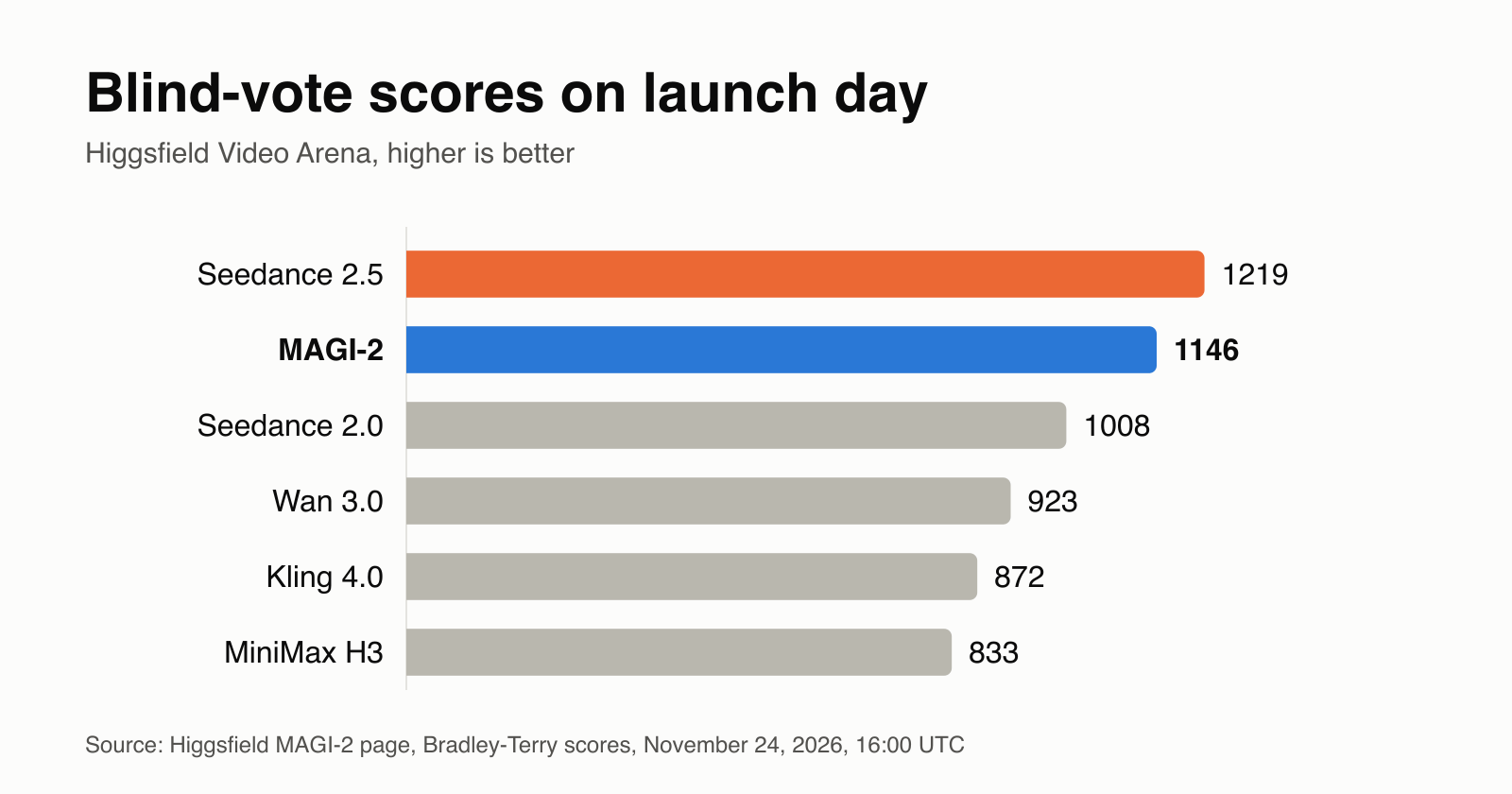
Higgsfield published MAGI-2's win rates against Seedance 2.0, Wan 3.0 and Kling 4.0, and left out the one against Seedance 2.5. We work that number out in MAGI-2 vs Seedance 2.5.
The independent evidence still points the same way as the paid posts. The difference is in the size of the claim: "close to Seedance 2.5, cheaper, weaker sound" is supported; "better than Seedance 2.5" is not.
Four prompts to run the same tests yourself
These are our own short versions of the day-one tests. Run them on MAGI-2 and on any model you already use, and compare first results without rerolling.
Orbit and crane (camera control):
One continuous take, handheld phone look, 28mm. Track a woman in a long grey coat from the side as she walks along a rooftop. Arc behind her, rise to a top-down view, descend in front of her and hold a close-up of her face for one second, then pull back and up to a wide view of the city at dusk. Buildings near the camera shift faster than distant ones. No cuts.
Follow an object through rooms (spatial consistency):
One continuous take. A paper plane leaves a classroom window, glides along the outside wall of the school past a row of windows, turns in through the open door of the ground-floor hall, crosses the hall and lands in a girl's open hand on the lawn outside. The camera follows from behind, passes under the wing once, and never goes through a wall.
Five impacts (physics):
Handheld phone footage, natural light, hard cuts on each impact. A boot kicks apart a knee-high pile of fresh snow. A glass jar of hard sweets drops on kitchen tiles and shatters, sweets bouncing in every direction. A shaken bottle of cola hits the floor and sprays brown foam, knocking over paper cups. A needle pops a clear balloon filled with coloured powder. Real-time speed, no slow motion. Sound: only what the phone would record.
Bottle pitch (sound and voice):
A quiet classroom, no music. A teacher taps a glass bottle holding a little water with a small wooden mallet and says, "Close your eyes and remember this note." She pours water in until the bottle is half full, waits for the pouring sound to stop, and taps the same spot again. The second note is clearly lower. She looks at the camera and asks, "Higher or lower?"
Check four things: whether the stairs-free route stays solid, whether the cola is brown, whether the sweets stay whole in slow playback, and whether you would believe the voice with your eyes closed.
Who should use MAGI-2 now
- Ad variants and short-form at volume: yes. At $2.40 for 30 seconds of 1080p, testing many hooks is cheap, and low reject rates matter more than the last few percent of texture.
- Camera-led shots, product reveals, stylised animation: yes. This is where it tested best.
- Dialogue scenes and anything voice-led: not yet. Use Seedance 2.5, or plan to redo the audio.
- Shots you need to match across models or grade heavily: test first; the contrast is strong out of the box.
- Running it yourself: not possible today. See whether MAGI-2 is open source for what is released and what it would take.
FAQ
Is MAGI-2 better than Seedance 2.5?
Not overall. In the first day of tests it matched or beat Seedance 2.5 on camera moves and prompt-following, came slightly behind on physics and picture texture, and clearly behind on sound. It costs far less per second.
How long can MAGI-2 videos be?
Up to 30 seconds per generation at 1080p and 25 fps, with sound.
How much does MAGI-2 cost?
$0.08 per second on Higgsfield, so $2.40 for a 30-second 1080p clip. In China it runs on LibTV, where Kazik reports ¥0.5 per second at 1080p.
Can MAGI-2 generate dialogue?
Yes, with lip-sync, and testers have shown Chinese and Japanese lines. The voices sound more synthetic than Seedance 2.5's.
Is MAGI-2 on Yovid?
No. At launch it is exclusive to Higgsfield outside China. Yovid's MAGI-2 page tracks its status. For 30-second takes with sound on Yovid today, use Seedance 2.5 or Wan 3.0.
Who makes MAGI-2?
Sand.ai, a Beijing video-model company led by Cao Yue. It released MAGI-1 in 2025 and the open MAGI-2 Preview in August 2026.
Want to run the four test prompts now? Open the AI video generator, choose Seedance 2.5 and start with a 480p draft.